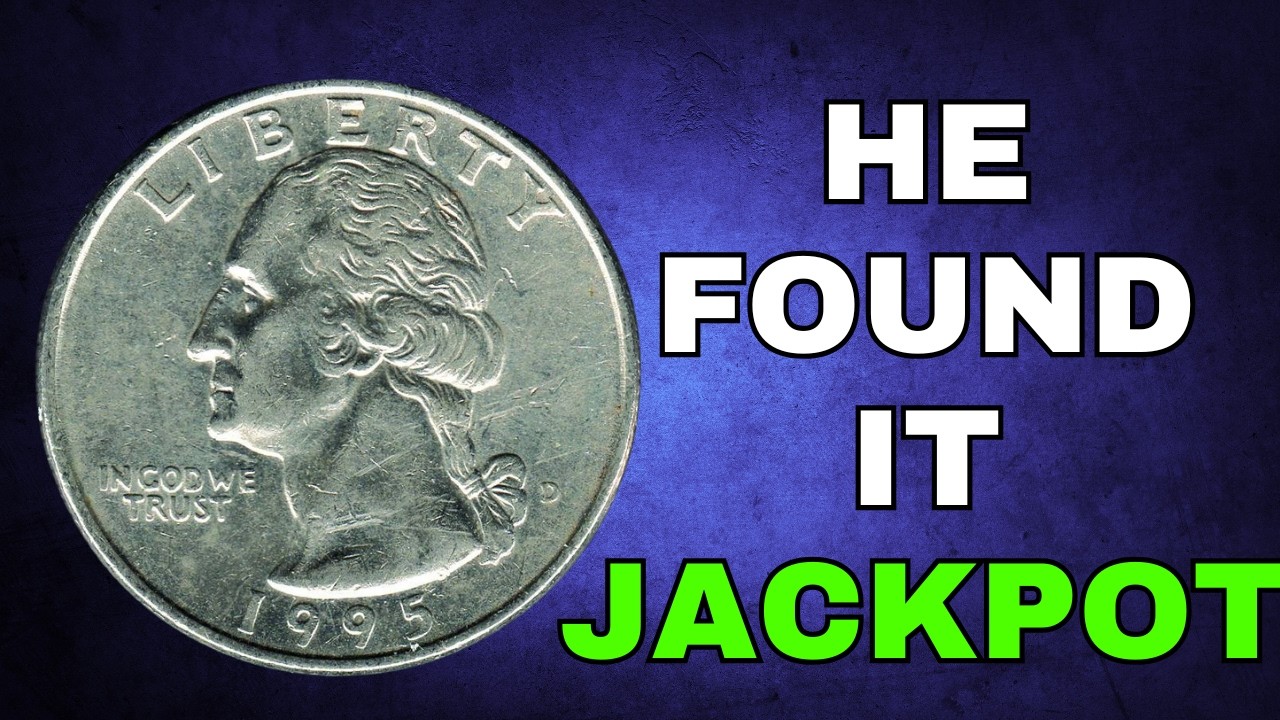
We’ve all done it—sorted through a handful of loose change, briefly glancing at dates and mint marks before mindlessly spending another quarter. To the untrained eye, a 1995 Washington quarter is just another 25-cent piece, destined to be exchanged for a gumball or a parking meter. But within the secretive halls of numismatics, this common-date coin holds a tantalizing promise: the potential to be a secret goldmine worth thousands of dollars.
This isn’t a myth or wishful thinking. It’s a documented reality fueled by condition, rarity, and dramatic minting errors. In this comprehensive guide, we’ll dissect the fascinating journey of the 1995 quarter from face value to four figures. We’ll analyze real-world sales, decode the critical factors that create immense value, and equip you with the knowledge to scrutinize your own pocket change for hidden treasure.
The Foundation: Mint Marks, Grades, and the Language of Value
Before diving into the case studies, understanding the basic lexicon is crucial.
- Mint Marks (1995-P & 1995-D): In 1995, quarters were struck at the Philadelphia (no mint mark or “P” on some sets) and Denver (“D”) mints. Billions entered circulation, making high grade and errors the true differentiators.
- The Sheldon Grading Scale (1-70): This is the universal standard. A grade of MS (Mint State) 60-70 means an uncirculated coin. For a modern quarter, a grade of MS67 or higher is exceptional, indicating pristine surfaces with minimal contact marks.
- Proof Coins: Specially made for collectors, these feature mirror-like fields and frosty designs. A “PR” or “PF” grade precedes the number (e.g., PR68).
Case Study 1: The Premium-Grade Common Coin
The Coin: 1995-P Quarter, Graded MS67.
The Sale Price: $33.
The Lesson: This coin represents the foundational layer of value: superior preservation. Turning 25 cents into $33 is a staggering 13,100% return. It lacks any visible wear, with full original luster and sharp details. For collectors completing high-grade “type sets,” such coins are essential. However, it highlights a key point: for mid-range values, the cost of professional grading must be factored into potential profit.
Case Study 2: The Proof with a Captivating Error
The Coin: 1995-P Quarter, Proof, Doubled Die Obverse (DDO), Graded PR68.
The Sale Price: $192.
The Lesson: Here, value multiplies through rarity and error. The Doubled Die Obverse (DDO) error is clearly visible as a shadow or doubling on the date and inscriptions like “IN GOD WE TRUST,” caused by a misalignment during the die-hubbing process. Combined with its proof status—made for collectors with exceptional strike quality—this coin becomes a desirable specialty item. As noted, a single grade higher could have pushed its value significantly further.
Case Study 3: The “Sleeper” in Elite Condition
The Coin: 1995-P Quarter, Graded MS68.
The Sale Price: $35.50.
The Lesson: At first glance, this seems identical to the $33 MS67 coin. But in the hyper-sensitive world of grading, that single point represents a monumental leap in quality. An MS68 coin has even fewer microscopic imperfections, near-perfect luster, and exceptional eye appeal. This is the ultimate “sleeper”—a coin that circulates unnoticed by the public but is instantly recognizable to savvy collectors and dealers who understand the premium for peak condition.
Case Study 4: The Perfect Storm: A $3,600 Quarter
The Coin: 1995-P Quarter, Graded MS68.
The Sale Price: $3,600 (at a 2019 auction).
The Lesson: This is the headline-maker and the ultimate lesson in market dynamics. On paper, it’s the same designation as the $35.50 coin. So, why $3,600?
- Condition Within the Grade: It was likely a “superb gem,” the finest-known example, at the very top of the MS68 population.
- Fierce Auction Competition: When two or more determined, deep-pocketed collectors decide they must own the same “best-in-class” coin, prices detach from guidebooks and soar.
- Market Timing: The 2019 market was ripe for such a sale. Coin values fluctuate with economic cycles and collector trends.
This sale proves that ultimate value is defined not just by metal and metrics, but by human desire and competitive bidding at the perfect moment.
Your Action Plan: How to Hunt for 1995 Quarter Treasures
- Start Sorting: Go through your jars of change. Separate any 1995 quarters (both with the “D” mint mark and the plain “P” from Philadelphia).
- Prioritize Preservation: Look for coins with full, original luster (a cartwheel sheen when rotated under light), no scratches, nicks, or wear on Washington’s hair or the eagle’s breast feathers.
- Error Hunt with Magnification: Use a 10x loupe or a macro camera lens. Carefully examine the obverse (front) for any doubling on the date or lettering. Compare it to a normal coin image online.
- Check Old Proof Sets: If you have a 1995 U.S. Proof Set, remove the quarter. Examine it under a bright light for its mirror surface and, again, check meticulously for any doubling errors.
- Research & Consider Grading: If you find a coin in seemingly flawless condition or with a clear error, research comparable sales on eBay “Sold Listings” or heritage auction archives. For potentially high-value coins, consider submission to PCGS or NGC for professional authentication and grading.
Final Verdict: More Than Just Pocket Change
The saga of the 1995 quarter is a captivating microcosm of numismatics. It teaches us that value is a complex alchemy of scarcity, preservation, error, and market sentiment. What appears common can be extraordinary under the right circumstances. So, the next time a quarter lands in your palm, pause for a second. Give it a look. You might just be holding a forgotten goldmine—a piece of modern history waiting for its true worth to be recognized.
Have you found a high-grade or unusual 1995 quarter? Share your discoveries and questions in the comments below! Let’s build a community of treasure hunters.
📌 Key Facts: 1995 Washington Quarter
- Composition: Cupronickel Clad (91.67% Cu, 8.33% Ni).
- Mints & Mintages: Philadelphia (P, 1.8 Billion+), Denver (D, 1.4 Billion+).
- Key to Value: Condition (MS67+), Errors (DDO), Proofs, and Market Demand.
- Record Sale: $3,600 for a 1995-P MS68 (as of 2019).
Case Study: The $3,600 Jackpot
Coin: 1995-P Quarter, MS68
Sale Price: $3,600 (2019)
Why? A perfect storm of top-tier condition within the grade, fierce auction bidding, and ideal market timing. This highlights that numismatic value often transcends printed guides.